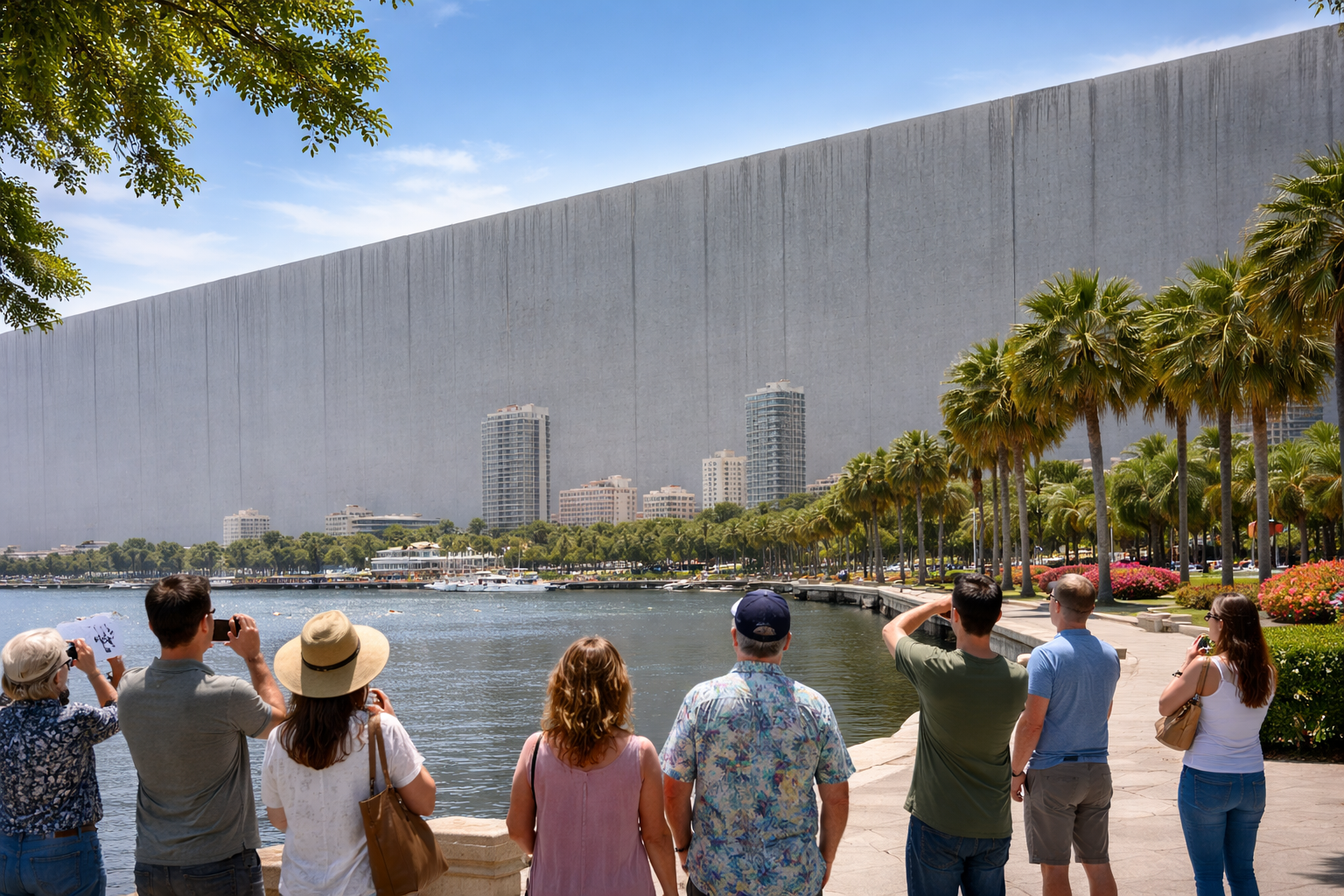
St. Pete officials are studying how to repair and reinforce the city’s aging seawalls. It’s the kind of infrastructure work that sounds boring until you remember it’s the only thing standing between the waterfront and the Gulf of Mexico getting ideas.
The city’s seawall study is meant to explore long-term fixes. Rising seas. Stronger storms. More nuisance flooding. The usual Florida math.
But it didn’t take long for the conversation to jump from “maintenance” to something that sounded like it came from a medieval war room.
A 400-foot seawall.
To be clear: no one is saying St. Pete is actually building a 400-foot wall tomorrow. But the number has entered the public bloodstream, and now the city is split into two camps — those who think it’s an absurd overreaction, and those who think it’s the first time anyone has spoken to the Gulf in a language it might respect.
At a recent public discussion tied to the seawall study, officials framed the work as planning — a sober, long-term approach to keeping the waterfront intact. The study includes everything from nature-based solutions to hard infrastructure.
But the “big wall” scenario was the one that stuck.
Some residents heard “400-foot seawall” and immediately pictured the waterfront turning into a concrete barricade — a vertical slab blocking the bay, the breeze, and St. Pete’s most important civic asset: the ability to stand near water and feel like your life is going well.
Others heard it and felt something they haven’t felt in years: relief.
“I’m not saying I want a wall that tall,” said one resident after the meeting. “But I am saying I’m tired of acting like the water is our friend.”
That sentiment landed. For a growing number of people, the waterfront doesn’t feel like a vibe anymore. It feels like a recurring expense.
Insurance. Repairs. Floodwater. Sand loss. Storm surge. More “historic” weather events. The list is long. And there’s a faction of residents who want St. Pete to stop flirting with resilience and start committing to something that looks like it could win a fight.
They want the wall.
On the other side: residents and environmental advocates who are already exhausted by the city’s tendency to treat complex ecological problems like they can be solved with a contractor, a ribbon-cutting, and a logo.
They worry a mega-seawall would disrupt habitats, worsen erosion, and shift impacts down the shoreline — basically solving the problem for one stretch of waterfront and handing it to the next.
They also pointed out the obvious: the bay is not a decorative pond.
“You can’t just build a fortress and pretend it’s still a waterfront city,” one speaker said during public comment.
That line hung in the air for a moment — the way it does when half the room agrees and the other half is quietly wondering how tall 400 feet actually is.
City staff attempted to pull the discussion back to reality. The 400-foot wall is not a formal proposal. It’s a high-end scenario included to model long-term risk and compare outcomes across different approaches.
This did not stop residents from reacting as if construction crews were already pouring concrete on Beach Drive.
Some demanded the wall be scrapped entirely. Others wanted it taller. Several asked if there could be a “compromise wall,” one that stops storm surge but still allows water views — a sentence that could only be spoken at a St. Pete public meeting without irony.
Officials stressed that the study is still underway and no decisions have been made. More public sessions are planned.
If the first meeting was any indication, the next one will cover the same three topics, in the same order: flooding, aesthetics, and whether anyone is allowed to interfere with a sunset in St. Petersburg without committing a crime.


Lorem ipsum dolor sit amet, consectetur adipiscing elit. Suspendisse varius enim in eros elementum tristique. Duis cursus, mi quis viverra.