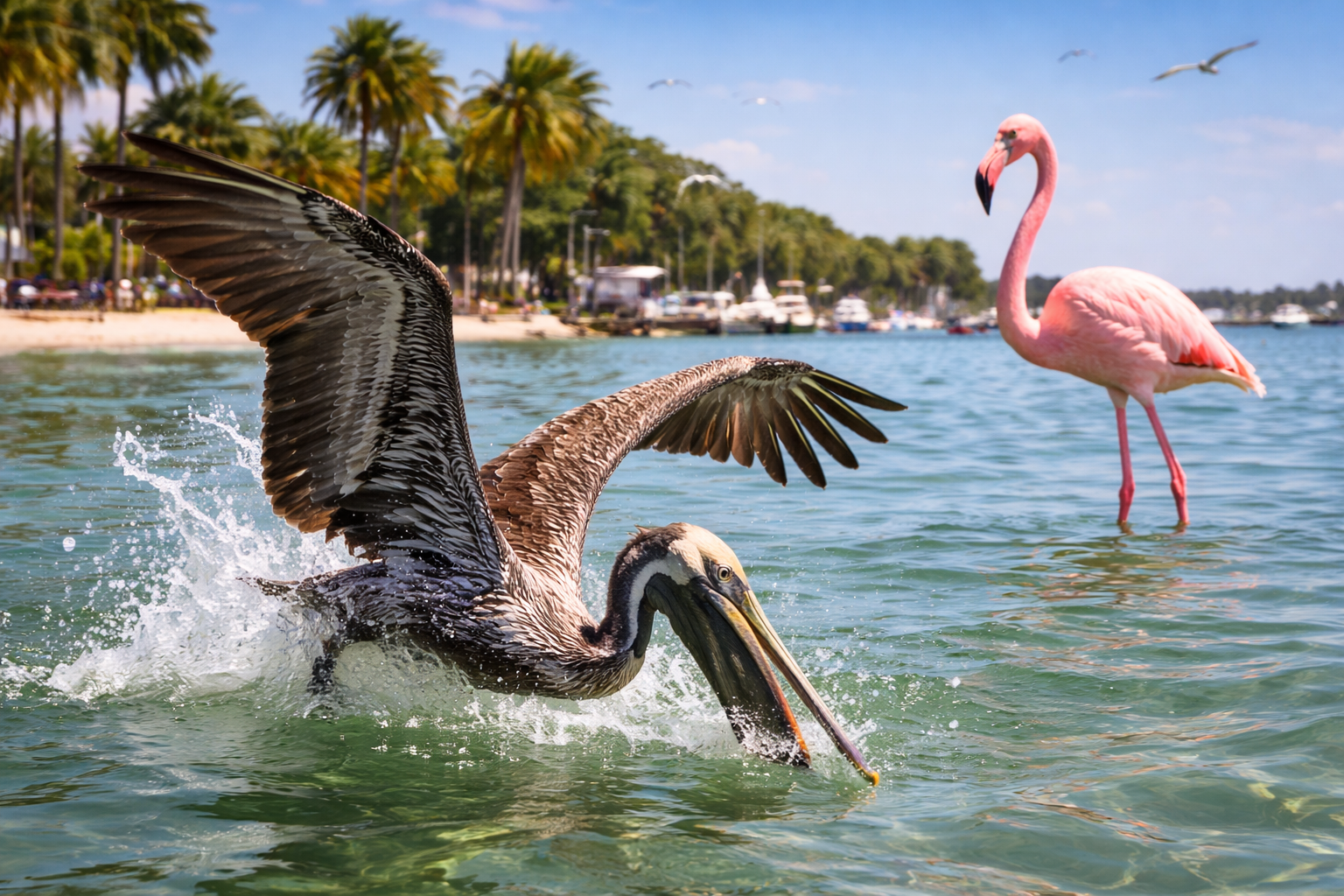
Florida officially adopted the flamingo as a state bird this year, a move lawmakers described as celebratory and obvious.
Across the Gulf Coast, the reaction has been more along the lines of: “Sure. For tourists.”
The flamingo — tall, pink, elegantly curved — now joins Florida’s official symbols, posing in shallow water like it just won something. Which, technically, it did.
“It looks smug,” said one St. Petersburg resident. “Like it knows it just got promoted.”
Since the announcement, locals have quietly begun backing an unofficial counterpoint: the brown pelican.
If the flamingo is Florida in a brochure, the pelican is Florida on a Tuesday.
The pelican does not pose. It hovers awkwardly, commits fully to a dive-bomb, and slams into the Gulf like it misjudged the distance. It swallows fish whole. It steals bait. It stands on dock pilings with the expression of a bird that’s seen several insurance cycles come and go.
“That’s the bird that’s been here,” said a Clearwater fisherman. “Not the one that looks like it just got off a cruise.”
Supporters of the flamingo argue it’s native, iconic, and globally recognizable — a bright, unapologetic symbol of the state’s flair.
Critics counter that it feels more like a marketing decision than a lived experience.
“The flamingo is aspirational Florida,” said a Pinellas County woman who recently watched a pelican inhale half a Publix sub without chewing. “The pelican is actual Florida.”
Meanwhile, the flamingo has done little to soften perceptions. It continues standing in pristine lagoons, balancing effortlessly, projecting what several residents described as “winning energy.”
The pelican, by contrast, appears perpetually damp and mildly irritated.


Lorem ipsum dolor sit amet, consectetur adipiscing elit. Suspendisse varius enim in eros elementum tristique. Duis cursus, mi quis viverra.