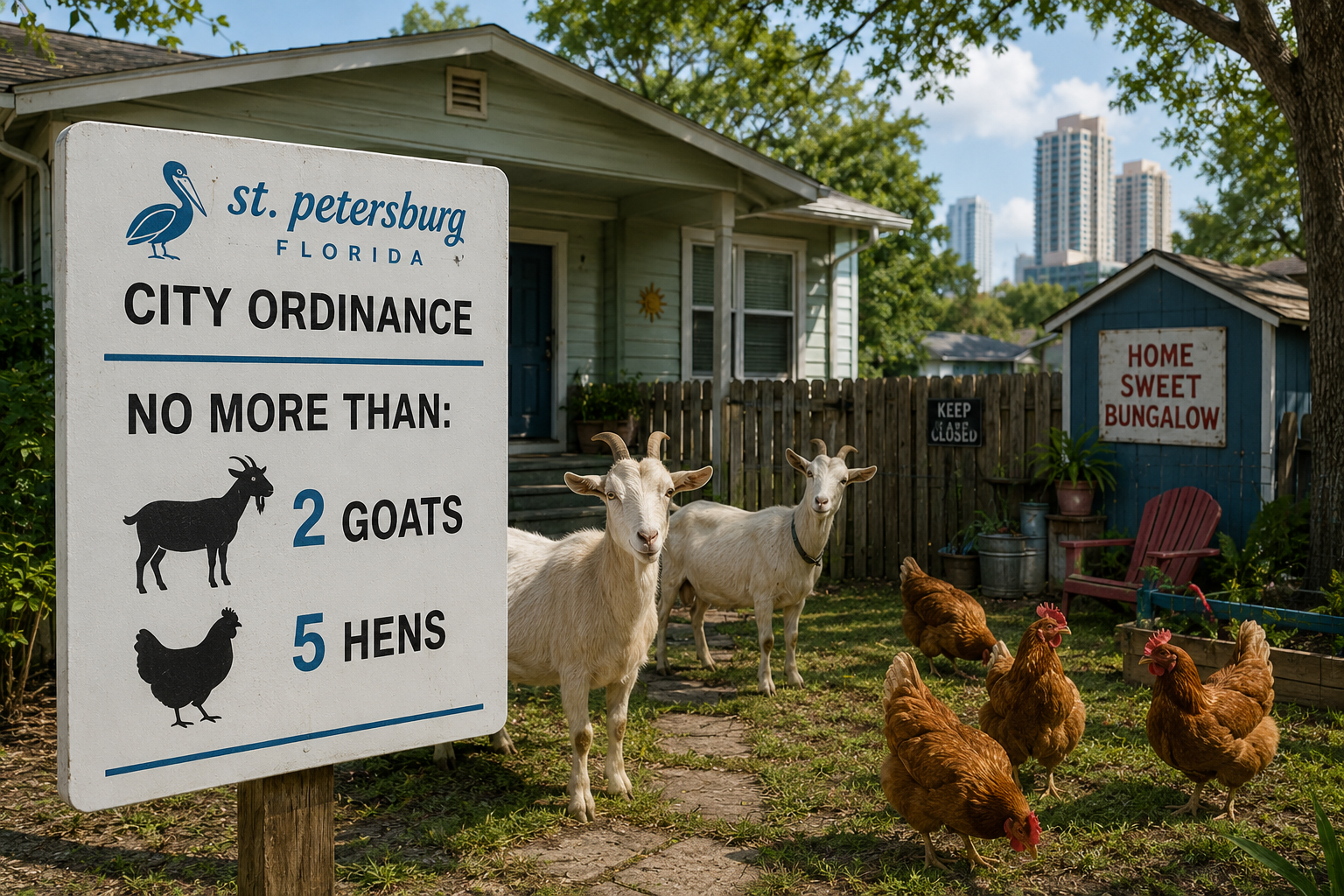
A local lobbyist and urban agriculture advocate petitioning St. Petersburg to allow residents to keep more than two goats and five hens on their property has inadvertently alerted city officials to an ordinance they apparently had no idea existed.
The discovery came after longtime civic advocate Mark Reynolds contacted the city seeking support for what he described as a modest modernization of St. Petersburg's outdated backyard livestock limits.
“I went in prepared to make the case for four goats,” Reynolds said. “They were much more interested in the part where I said we were currently allowed two.”
According to Reynolds, his proposal would increase the number of goats and hens permitted at a typical residential property, giving residents greater freedom to raise small livestock in their backyards.
City staff initially responded by asking him to send over the ordinance he wanted changed.
“I thought they meant the section number,” Reynolds said. “No. They wanted me to send them the actual ordinance because nobody could find it.”
The request reportedly triggered several days of research inside City Hall as employees searched old municipal records, zoning regulations and animal-control provisions to determine why residents of St. Petersburg were apparently entitled to two goats.
“We deal with parking, development, stormwater, zoning, code enforcement — all kinds of things,” said one city employee. “Goat allocation doesn't come up as often as you'd think.”
Officials eventually confirmed that some provision, written long before the city's current era of luxury apartments and rooftop bars, appeared to establish surprisingly specific limits on backyard livestock.
Several employees reportedly reacted to the discovery by asking the same question.
“Wait, we can have goats?”
Reynolds said the city's confusion only strengthened his argument that the ordinance was overdue for reconsideration.
“If nobody at City Hall knows why the limit is two goats, I think it's fair to ask why it can't be four,” he said.
City staff pushed back on that reasoning, noting that not knowing why a law exists is not necessarily sufficient justification for doubling the number of goats.
“There's probably a reason somebody picked two,” one official said. “We just haven't found that person yet.”
The debate has since expanded beyond Reynolds' original proposal, with officials attempting to determine precisely what problem the existing ordinance was designed to prevent.
Meeting notes reportedly included questions such as “Why two?”, “Why five hens?”, “What happens at goat three?” and, underlined twice, “How long has this been legal?”
One planning employee suggested the two-goat threshold may represent the point at which backyard animal ownership transitions from a residential hobby into livestock farming.
“Two goats feels quirky,” she explained. “You drive past a bungalow and see two goats, you think, ‘Oh, that's St. Pete.’ You see six goats and you're going to have follow-up questions.”
Reynolds disagreed, arguing that the city's rapidly growing population should be accompanied by a proportional increase in residential goat capacity.
“We've added tens of thousands of people,” he said. “Yet the goat limit has remained completely stagnant.”
His proposal has already generated interest among residents who had never previously considered owning a goat and, until hearing about the controversy, did not know they were legally missing out on two.
“I don't even want a goat,” said Kenwood resident Lisa Martinez. “But now that I know the city says I can only have two, I want to know who decided that.”
Martinez said she was particularly troubled by the five-hen limit.
“Five is very specific,” she said. “Somebody sat in a room and decided six chickens was too many chickens. I want to see the minutes from that meeting.”
City commissioners are expected to review Reynolds' proposal after staff determines what the current ordinance actually says, why it says it, whether anyone has ever enforced it, and what administrative consequences could result from increasing the city's maximum allowable goat population.
Officials emphasized that residents should not interpret the review as an invitation to immediately acquire livestock.
Reynolds, meanwhile, said he remains optimistic that St. Petersburg will eventually increase the limit.
“This is about personal property rights,” he said. “If somebody has enough room, takes care of the animals and isn't bothering their neighbors, I don't think City Hall should arbitrarily tell them they can have two goats but not three.”


Lorem ipsum dolor sit amet, consectetur adipiscing elit. Suspendisse varius enim in eros elementum tristique. Duis cursus, mi quis viverra.