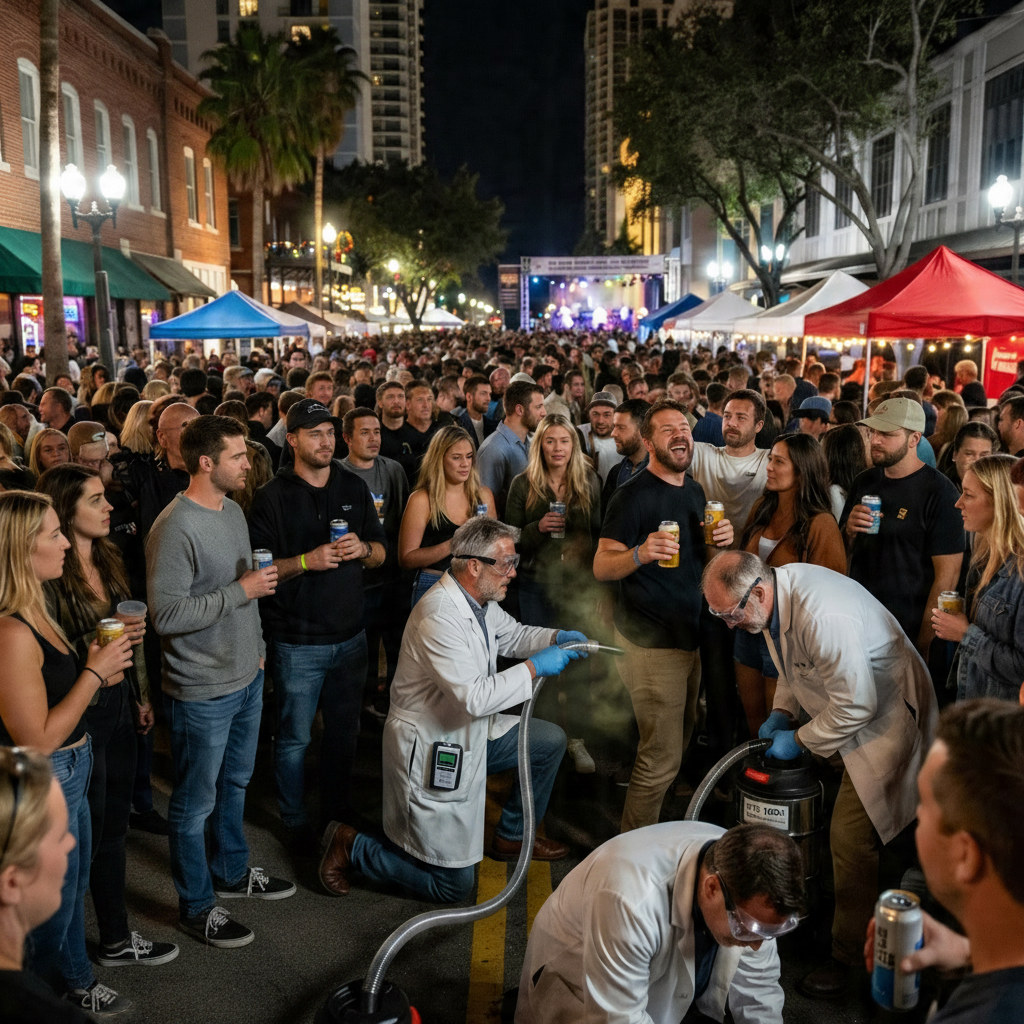
A newly launched local startup is drawing national attention for what its founders describe as “the next frontier in sensory data science,” though most observers would describe it more simply as a very committed study of flatulence.
The company, Gastro Analytica, officially debuted its flagship platform, Fartificial Intelligence, this week — a machine learning system designed to identify, classify, and organize human emissions into a formal taxonomy system modeled after biological science.
“We’re bringing order to chaos,” said co-founder and CEO Derek Mullins, standing beside what appeared to be a stainless steel folding table outfitted with sensors, tubes, and what he confirmed was “a heavily modified shop vac.” “For too long, these events have been dismissed as random or purely recreational. In reality, there’s structure, hierarchy, and frankly, elegance.”
According to Mullins, the platform categorizes outputs across multiple scientific levels. At the highest level sits the phylum Flatulum, followed by class Gaseae. From there, the system branches into more specific orders, including Odoriformes for scent-heavy emissions and Silentia for those “operating in stealth mode.”
A particularly groundbreaking advancement, Mullins noted, is the company’s work on moisture classification.
“That’s been the missing piece in the field,” he said. “We’ve introduced a full suborder — Humidifera — to capture particulate density and what we call ‘splash potential.’ It’s delicate work, but the data is incredibly rich.”
To build its dataset, that startup has turned to one of St. Petersburg’s most consistent and high-output environments: the city’s monthly First Friday celebration. The event, known for its street closures, live music, and abundant supply of low-cost domestic beer, has proven to be what the company calls “a naturally occurring laboratory.”
“Our Gastro Analytica Sensors thrive in that ecosystem,” said Chief Technology Officer Amanda Reyes. “You’ve got a dense crowd, high carbohydrate intake, and a willingness among participants to fully express themselves. From a data standpoint, it’s ideal.”
Reyes said the team deploys discreet, waist-level collection units throughout the event, branded as “air quality monitors,” though she acknowledged that their function is “more targeted than that.”
“We’re not just measuring presence,” she said. “We’re analyzing tone, duration, velocity, and aromatic complexity. Some of these have layers — top notes, mid notes, and a finish that lingers.”
Early findings have already led to the identification of several distinct species within the system, including Flatulus abruptus, known for its short, percussive burst, and Flatulus lingerii, which “arrives quietly but refuses to leave.”
There is also a rare but notable classification, Flatulus panicus, typically associated with sudden crowd reactions and immediate dispersal patterns.
Investors have shown surprising interest. Mullins confirmed the company recently closed a $2.5 million seed round led by a group he described as “visionaries who understand that disruption sometimes smells a little different.”
Potential applications for the technology extend beyond entertainment. Mullins pointed to opportunities in healthcare diagnostics, environmental monitoring, and even security.
“You can learn a lot from these signals,” he said. “Diet, stress levels, microbial health — it’s all encoded. We’re essentially unlocking a new language.”
That language, it turns out, may be more literal than metaphorical.
According to early field data collected during multiple First Friday deployments, emissions are not occurring in isolation. Instead, researchers have observed what they describe as a “call-and-response communication structure,” in which one event appears to trigger a cascade of related outputs across a crowd.
“It starts with a single initiator,” Reyes explained. “Usually mid-block, often near a beer stand. Within seconds, you’ll see a localized response — two, maybe three nearby acknowledgments. Then it spreads.”
Within minutes, the system begins mapping what Gastro Analytica has dubbed “conversational clusters,” with distinct patterns of escalation, variation, and — in some cases — apparent mimicry.
“One subject produces a low, sustained tone,” Reyes said. “Another responds with a sharper, higher-pitched reply. You start seeing rhythm, spacing, even what looks like intentional contrast.”
The most striking discovery, however, is the speed at which these interactions scale.
“Within an hour, you’re no longer looking at isolated exchanges,” Mullins said. “You’re witnessing a fully emergent phenomenon — a coordinated, below-the-belt symphony moving through the crowd in waves.”
Internal visualizations provided by the company show dense heat maps of activity pulsing up and down Central Avenue, with color-coded bands representing intensity, duration, and what engineers refer to as “harmonic compatibility.”
“At peak, it’s almost orchestral,” Reyes added. “You’ve got sections — bursts over here, sustained notes over there, and transitional pockets that bridge the two. It’s not random. It’s structured.”
The company is now training its proprietary large leakage model to decode this emerging language, with plans to release what Mullins called “the first-ever translation layer” later this year.
“Right now, we can detect patterns,” he said. “The next step is understanding meaning. Are these greetings? Warnings? We don’t know yet.”
Back on Central Avenue, as another First Friday crowd begins to gather, Mullins remains confident the answers are close.
“We’re capturing something people have avoided for generations,” he said. “And if the data holds, we may have just discovered that, all along, people weren’t just passing time out here.”
He paused, glancing again at the live feed of incoming signals.
“They were talking.”


Lorem ipsum dolor sit amet, consectetur adipiscing elit. Suspendisse varius enim in eros elementum tristique. Duis cursus, mi quis viverra.